
How do you give AI agents speed on routine refactoring without letting them recklessly alter core infrastructure? In this architectural deep dive, we document how RunWield assesses request blast radius, when it triggers a mandatory human planning gate, how inline redlines refine the plan, and how the system validates final execution. Even this article benefited from a simple Plan: read the actual publication Plan that caught inaccuracies in the original draft and recorded the corrections before publication.
The core tension in autonomous software engineering is simple: speed versus safety. If you treat every prompt equally, you face an impossible choice. Either you put a human approval step in front of every trivial CSS adjustment, killing the velocity gains of using an AI agent, or you give the agent blanket autonomy, which eventually leads to a broken authentication pipeline or an unintended database schema drop.
At RunWield, our architecture resolves this by separating intent from execution through an intelligent routing layer. Before an execution agent is allowed to write a single line of code, the system assesses the blast radius of the request and adjusts its governance model dynamically.
Phase 1: Assessing the Blast Radius with the Router
When a coding request enters RunWield, it hits the Router first. Rather than relying on a rigid scoring formula, the Router is a calibrated agent equipped with specialized tools to inspect the codebase and detect the true blast radius of the incoming task.
The Router explores the repository context to see how deeply the targeted code is woven into the broader system. It checks whether the request is isolated to a leaf node, like a localized UI component, or if it touches a shared utility imported across dozens of modules. It also looks for architectural implications and hidden dependencies, such as a change that reaches authentication, billing, infrastructure configuration, or database schemas.
If the blast radius is contained and low-risk, RunWield grants the downstream agent autonomous execution privileges to write the code and run the project’s checks without interrupting the developer.
Phase 2: The Mandatory Human Planning Gate and Inline Redlines
When the Router detects a wide or high-risk blast radius, RunWield routes the request to a mandatory human planning gate. The system shifts to an architectural proposal mode and generates a structured Plan outlining the files it expects to change, the implementation steps, the risks, and how the change will be verified.
Execution is locked until an engineer approves this plan, preventing the agent from burning tokens on a massive, multi-file hallucination. Because approving a plan is rarely a binary yes or no, RunWield supports inline redlines directly within the Plan.
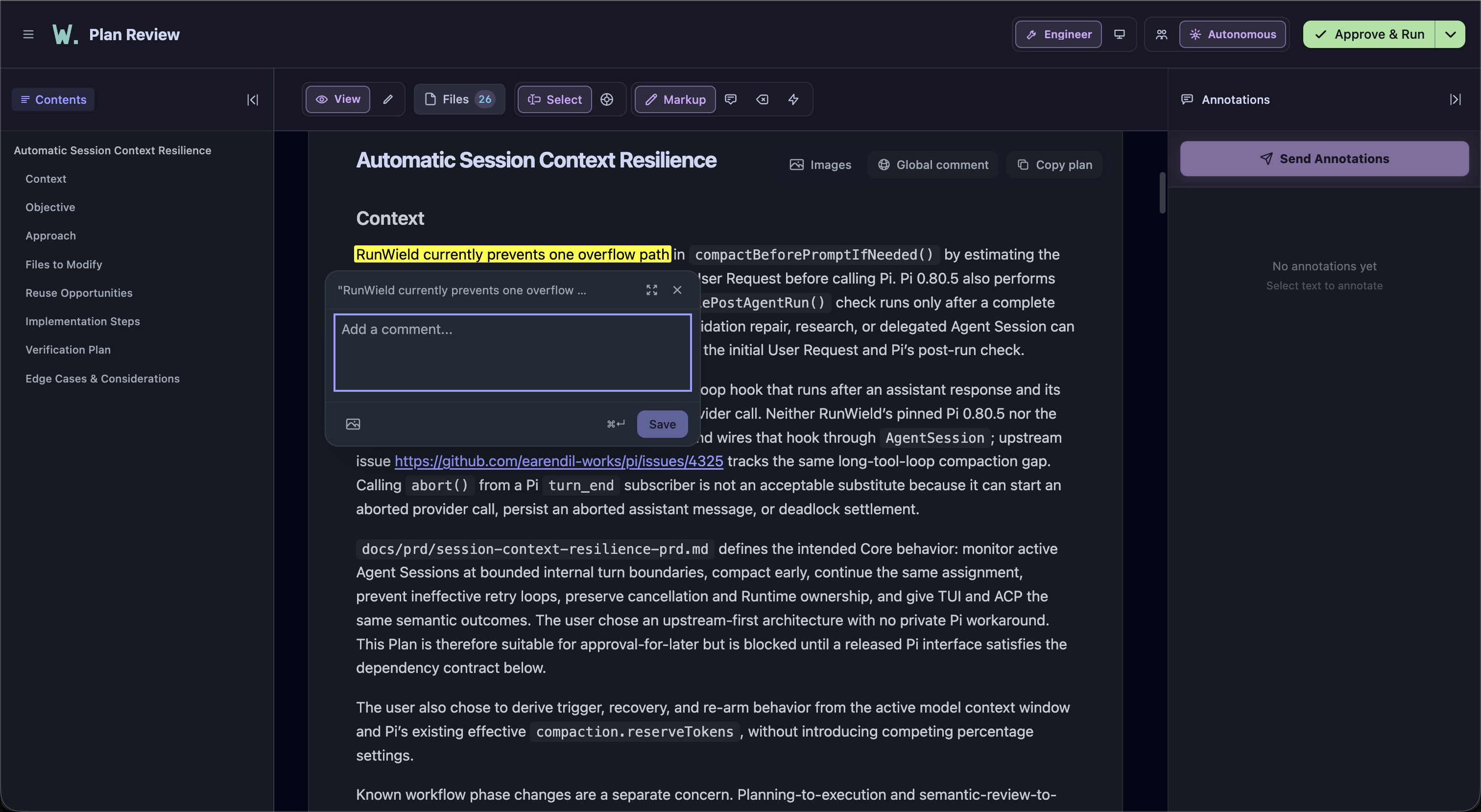
Instead of rewriting the original prompt when a plan is only eighty percent correct, engineers can highlight specific lines to strike through a proposed file modification, specify a different library, or lock a function signature. These redlines are sent directly back to the Planner, which rewrites the Plan to incorporate the exact corrections. Once the engineer approves the revised plan, the gate opens and the execution agent takes over.
Phase 3: Automated Validation and Clean-Context Diff Review
Once the execution agent writes the code, RunWield does not immediately hand it back to the developer. The output must pass through a strict validation pipeline. First, the system runs automated checks, including linting, type checking, and the relevant test suites, allowing the execution agent to self-correct any syntax or logic errors in real time.
After the deterministic checks pass, RunWield triggers an automatic clean-context review. A separate review agent, initialized with a fresh context window unpolluted by the execution agent’s trial-and-error reasoning, inspects the final git diff directly against the approved Plan.
This clean-context reviewer verifies that every requirement in the plan was met and checks for any unrequested changes or scope creep. If the diff deviates from the approved plan, it is rejected, and its findings go to a repair session before a human ever has to look at it.
Summary
True engineering velocity does not come from letting AI agents run wild in your codebase. It comes from knowing when to let them run and when to make them ask for permission. By combining the Router’s calibrated blast radius detection with human planning gates, iterative inline redlines, and clean-context diff verification, RunWield gives your team instant speed on routine refactoring while keeping human judgment firmly in control of your core infrastructure.
 Back to Wield Notes